

Setting the Stage: A Nation on Edge
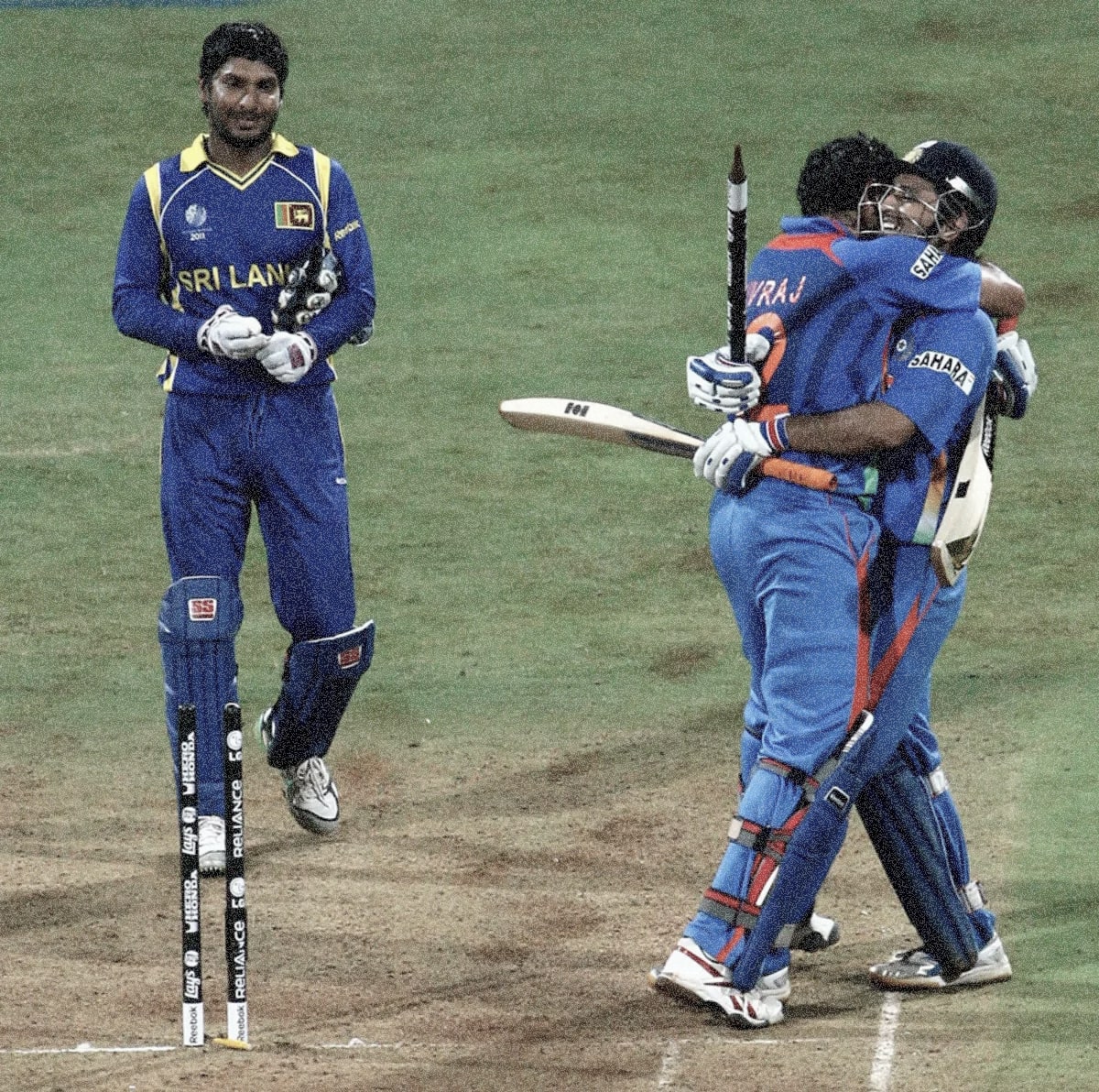
April 2, 2011. India came to a standstill. Streets fell silent, shops paused, and every home turned into a stadium. India wasn’t just playing a cricket match that day it was chasing closure, history, and a dream 28 years in the making. The Wankhede Stadium in Mumbai had never felt heavier. It wasn’t just eleven players on the field, it was 1.2 billion hearts beating in sync, riding every ball, every run, every emotion. This final looked like a remedy to the years of heartbreaks for fans.
The journey had been long, painful, and personal for Indian fans. The wounds of the 2007 World Cup exit were still raw. The team had returned home humiliated, and the fans had turned angry, even violent. But in those four years, something shifted. A new generation of fearless cricketers emerged, guided by the old guard. Virat Kohli’s aggression, Yuvraj Singh’s resurgence, Zaheer Khan’s precision, and of course, the calm commander MS Dhoni who stitched it all together.
But at the center of it all stood one man: Sachin Tendulkar. This wasn’t just a tournament for him, it was his sixth World Cup, his final shot at the one major trophy missing the center piece in his cabinet. For fans, it felt like a mission: Win it for Sachin. Every Indian, from the stands of Wankhede to the smallest village glued to a radio, was united in one hope.
The group stage had been solid. The quarterfinal against Australia was a statement. The semifinal against Pakistan was emotional warfare. And now, the final hurdle Sri Lanka. A team that had won the trophy in 1996, led by the elegant and dangerous Kumar Sangakkara. This wasn’t going to be easy. But for India, it was never about easy. It was about destiny.
And destiny, as we would soon witness, had a six written all over it.
The Wankhede Final: Hope vs Pressure
The atmosphere at Wankhede that evening was electric, yet almost sacred like a temple where every clap, chant, and silence carried prayer. Every face with shining eyes in the crowd wore the tricolour, every soul carried hope, and every heart knew: this wasn’t just any final.
The toss was a drama, a rare re-toss due to confusion. Eventually, Sri Lanka won and chose to bat. At first, India seemed to have things under control. Zaheer Khan started with three consecutive maidens tight, disciplined, and fierce. But as the innings progressed, Sri Lanka slowly clawed back. Mahela Jayawardene, graceful as ever, played the kind of innings finals are remembered for an unbeaten 103, full of timing, elegance, and silken strokes. Sri Lanka posted 274. A total that wasn’t out of reach, but in a World Cup final, pressure turns every run into a mountain.
And then came the gut punch.
First legal ball of the chase Sehwag gone, trapped LBW. Soon after, Tendulkar edged one to Sangakkara. The crowd turned from roars to stunned silence. Wankhede felt like it had the wind knocked out of it. The man everyone hoped would carry India home, like he had done for over a decade now, had walked back with just 18.
For a moment, the ghosts of 2003 reappeared. Would this be another heartbreak? Another near miss? Another nightmare? Another sad ending?
But then came a glimmer. Gautam Gambhir, gritty and fearless, took control and settled the nerves. Alongside a rising youngster, Virat Kohli, he stitched a partnership that brought hope back to the stands. Kohli’s 35 may not seem like much, but it was a statement of intent. The intent to win and conquer.
India was fighting back. Run by run, ball by ball. When Kohli fell, the match was still on a knife’s edge.
And then, MS Dhoni did something no one expected.
He promoted himself above a red-hot Yuvraj Singh. A man who had carried India throughout the tournament, despite silently battling cancer. The decision was bold, risky, and unorthodox.
But that’s Dhoni. The Captain cool, calculated under chaos.
The stadium didn’t know what to feel. Surprise? Doubt? Trust?
What followed would not only justify that decision, but it would also define an era.
The Night Dhoni Walked in Early
In the most high-stakes moment of Indian cricket, MS Dhoni made a move that only he could make. With India needing over 100 runs and Yuvraj Singh, Man of the Tournament waiting in the dressing room, Dhoni quietly padded up and walked in ahead.
It wasn’t bravado. It wasn’t defiance. It was instinct.
A captain trusting his own read of the situation.
Murali was still spinning webs, and Dhoni who had kept him for years in the nets at Chennai Super Kings knew his strengths, his rhythms. More importantly, he backed himself to handle the pressure, to anchor the innings, and to finish the job.
The early moments were cautious. He wasn’t middling everything. There were plays-and-misses. A thick outside edge here, a mistimed drive there. But what stood out was his body language calm, still, unshaken. He was a man chiseling away at destiny.
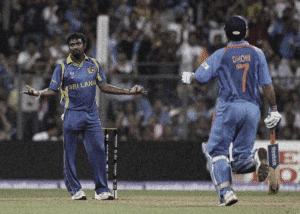
Alongside Gambhir, he began to slowly stitch India’s hope back together. Gambhir was fighting like a warrior gritty, determined, no fuss. Dhoni, at the other end, was slowly finding his rhythm. A nudge here, a firm push there. No wild shots. No desperation. Just trust in the process.
Every run reduced the pressure. Every boundary brought a roar. And soon, Wankhede believed again.
Then came a heartbreaking moment Gambhir fell for 97, three runs short of what would’ve been a historic hundred. But what he had done was more than enough. He had laid the foundation. He had pulled India back from the edge to the centre.
From there, it was Dhoni’s script to finish, And to finish the job he had started four years ago when he became captain.
He switched gears. The flicks got crisper. The drives more commanding. The gaps easier to find. When Yuvraj finally walked in, the match had tilted. From fear to belief. From pressure to purpose. From silence to roars.
What Dhoni was doing now wasn’t just batting.
It was composing calmness in chaos. It was the madness unleashed on the Lankan bowlers.
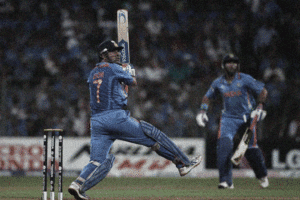
As the target neared, the crowd began sensing it. The chants got louder. The flags waved harder. The air turned heavier. Something special was coming.
You could feel it. You could hear it.
The Vande Mataram being sung in the stands.
The Six That Froze Time
It was the 49th over. Just five runs to win. And the tension inside Wankhede could’ve cracked concrete. You’d think, with the match nearly sealed, fans would be relaxed. But no. Not in India. Not after 28 years of waiting.
Nuwan Kulasekara had the ball. 275 was the target. India sat at 270. Yuvraj was on strike, full delivery outside off stump, squeezed out to point for a single. That brings the Captain Cool on strike, four more runs needed…
Then it happened.
A full delivery from Kulasekara. Dhoni stepped forward, bat swinging in one fluid motion. Time slowed. The sound, that sound off the middle of his bat rang like thunder. It wasn’t a desperate slog. It was precise. Clean. Poetic.
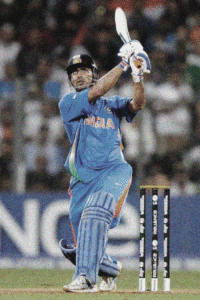
The ball sailed high. Higher. Into the night sky.
And as it disappeared into the stands beyond long-on…
…a billion hearts exploded in unison.
The crowd erupted. Fireworks lit the Mumbai sky. Ravi Shastri’s voice, now immortal, cut through the noise:
“Dhoni finishes off in style… India lifts the World Cup after 28 years… and it’s the Indian captain who’s been absolutely magnificent…”
It wasn’t just a six.
It was a release.
Of pain. Of heartbreak. Of missed chances.
It was 2003, 1999, 1996, all missed opportunities fading away in one glorious swing.
MS Dhoni stood there, bat raised, calm as ever as a monk in the eye of a storm. Yuvraj rushed in. The team followed. Sachin Tendulkar stood on the sidelines with moist eyes. Virat Kohli would later carry him on his shoulders. And every Indian no matter where they were felt like they were at Wankhede that night.
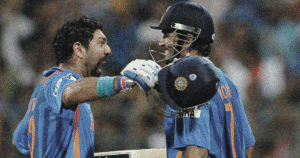
For one moment, cricket wasn’t just a sport.
It was joy, justice, and homecoming, a religion every Indian believed in all at once.
Beyond the Boundary: What That Six Meant
When Dhoni launched that six, the scoreboard changed. The result changed.
But something deeper changed that night.
For every Indian who had stayed up late watching heartbreaks in 1996, 1999, 2003…
For every fan who had dreamt of seeing Sachin Tendulkar lift a World Cup…
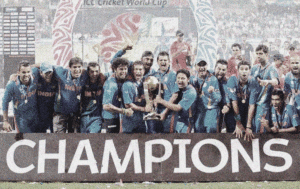
For every child who had mimicked a cover drive on the street with a plastic bat…
That six was not a winning shot. It was a shared triumph. A national exhale.
It was validation for Yuvraj Singh, who had silently battled cancer while carrying India on his shoulders throughout the tournament.
It was poetic for Zaheer Khan, who had endured the scars of the 2003 final but now led the bowling attack with fire and grace.
It was a moment of redemption for Gautam Gambhir, the unsung warrior of the final.
It was the proof of ability for MS Dhoni, questioned for his captaincy and batting ability.
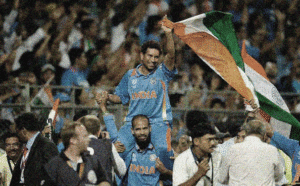
And it was the fulfilment of a billion prayers for Sachin Tendulkar, carried on shoulders around Wankhede like a king returning from battle.
Virat Kohli summed it up best:
“He’s carried the burden of the nation for 21 years. It’s time we carried him.”
This wasn’t just the end of a match.
It was the end of waiting. The end of doubt.
It was the night Indian cricket came full circle.
From 1983 to 2011, from Kapil’s lift to Dhoni’s launch, the story had found its echo.
Different eras. Same dream. Same gold.
Legacy of a Helicopter
That final shot the helicopter six is now etched deeper into Indian memory than any flag, any anthem, any photograph. It wasn’t just Dhoni finishing the match.
It was Dhoni completing a chapter of history, fulfilling the dreams of a billion fans, celebrating the legends with grace, calm, and silent strength.
In that moment, he didn’t scream. He didn’t fall to his knees.
He just stood there.
As if he already knew. As if he always believed it would end like this. This calmness, even in tense situations, is what MS Dhoni gave to the team. It’s not like he never got angry; he too had his moments of rage and fury, moments where his smile turned into bold actions. But this was not one of them. He knew that his actions spoke much louder than his rage ever could. Those rare flashes of emotion are captured in When Captain Cool Lost His Cool, reminding us that even the calmest minds carry fire within.
And that’s the legacy of MS Dhoni.
Not just a finisher. Not just a captain. But a man who knew when to be bold, when to be still, and when to lift an entire nation without ever saying a word.
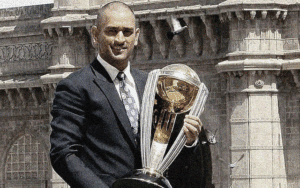
That six became a symbol.
Of leadership without noise.
Of nerves of steel under pressure.
Of India’s rise not just as a cricketing force, but as a united emotion.
Today, kids growing up don’t just want to hit a six, they want to hit that six.
They don’t just want to win, they want to finish with the poise of a man who redefined Indian cricket.
April 2, 2011, wasn’t just the day India won a trophy.
It was the day cricket, once again, became our language of dreams.
And it all ended with one unforgettable shot…
A helicopter that carried a nation into history.
That six wasn’t just Dhoni’s it was yours. Mine. Ours.
It was the memory you’ll never forget, the shout you’ll never repeat the same way, the tears that meant more than just cricket.
And at Bluefever, we don’t just watch moments, we relive them.
We collect them. Frame them. Wear them. Celebrate them.
Because moments like April 2, 2011, are not just pages in a record book.
They’re emotions stitched into who we are.
So, here’s our question to every Indian cricket fan:
Where were you when Dhoni hit that six?
Tell us. Because your story is part of the legacy too.


