

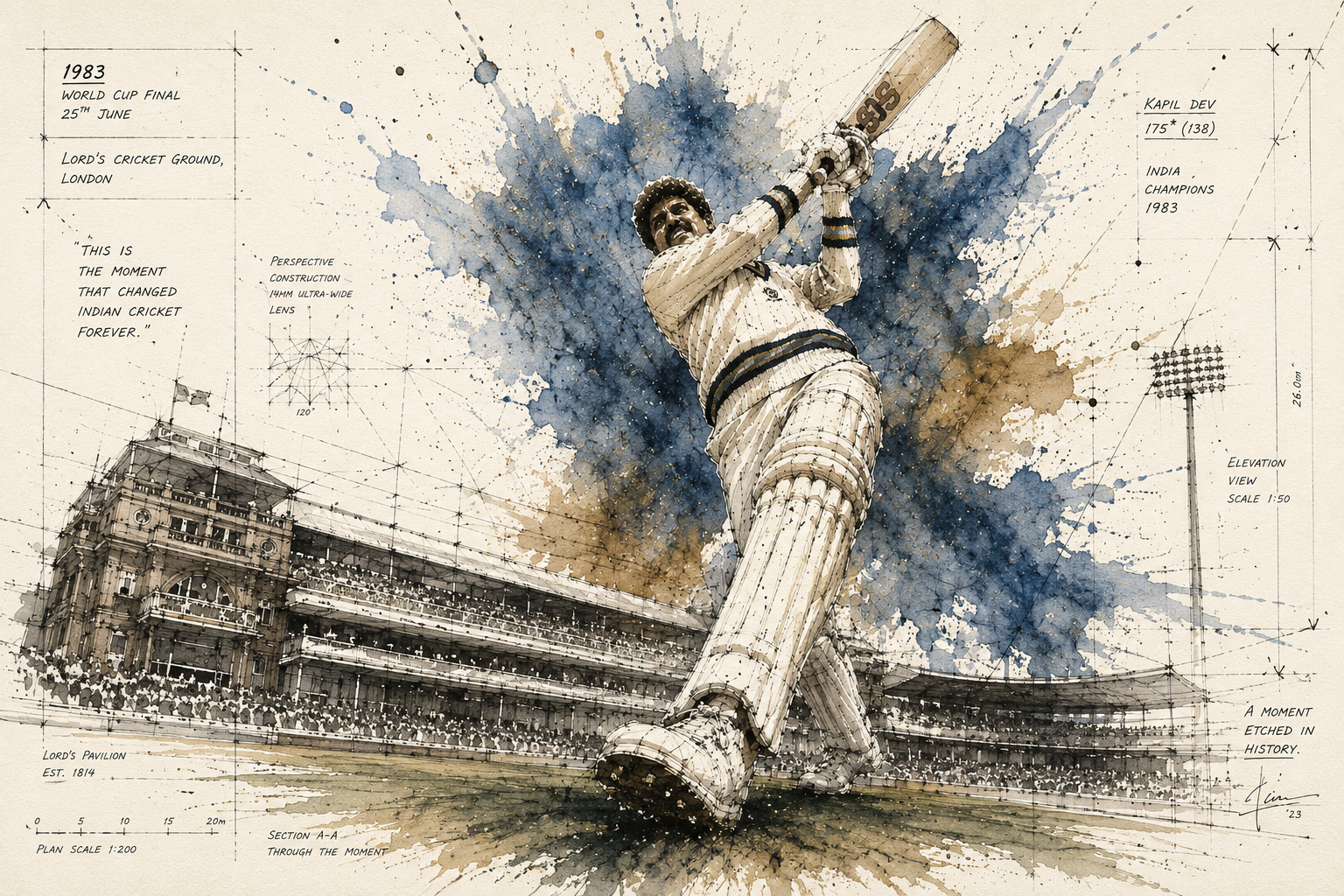
There are moments in sport that stop time. Not because of bright lights, camera angles, or commentary, but because a single human being decides to fight when everything else seems lost. Kapil Dev gave India many such moments. He didn’t just score runs. He carried the dreams, the fear, the pride, and the uncertainty of a young cricketing nation on his shoulders.
Many young fans today know the names of the modern firebrands. But before they existed, before confidence became natural and aggression became mainstream, there was Kapil Dev, a man who played with the heart of a warrior and the smile of a boy who simply loved the game.
This list is not about numbers. It’s about the emotion behind those numbers. It’s about the innings that transformed matches, inspired teammates, and ignited a spirit inside millions of Indians. It’s written for the youth of today, who sometimes forget how courage looked before there were cameras from every angle.
Here are Kapil Dev’s five greatest innings, retold with the rawness and drama they deserve.
5) 116 vs England – Kanpur, 1982: Quiet Courage, Silent Strength
Not every heroic inning comes with fireworks. Some come with grit, sweat, and quiet endurance.
Kapil’s 116 against England in 1982 is one such knock. It was not flashy. It did not involve impossible shots. But it held India’s innings together at a time when a collapse could have destroyed the match.
In Kanpur’s afternoon heat, with the pitch testing every technique, Kapil chose discipline. He defended when he needed to, attacked only when it was wise, and slowly built a century that gave India stability.
This innings is important because it shows another side of Kapil Dev, the side of a man who knew when to stay calm. Not every battle needs aggression. Sometimes the bravest thing you can do is stick to your plan, trust your technique, and refuse to panic.
For the youth who think success must always be dramatic, this innings is a reminder: consistency wins battles. Steadiness builds character.
4) 126 vs West Indies – Delhi, 1979: A Young Man Challenges the Dominators
To understand the importance of this innings, you have to understand the West Indies of that era. They were not just the best team in the world. They were the force, fast bowlers who made even the bravest batsmen nervous, a batting lineup that could destroy any attack, and an attitude that came from years of dominance.
For a young Indian player to score a century against them was nothing short of an announcement.
Still early in his career, Kapil walked in facing this mountain of a team. And he hit 126: bold, fearless, and full of young fire. He didn’t play like someone intimidated. He played like someone who believed he belonged.
This inning mattered because it broke a mental barrier. It signaled the arrival of a new kind of Indian cricketer, someone who didn’t play with fear in his eyes. Someone who chose courage over caution.
That century is the story of a young man daring to challenge giants. And it tells every young Indian today: you don’t need to wait for the world’s approval. Start fighting for your place. The world will adjust.
3) 163 vs Sri Lanka, Kanpur, 1986: The Art of Building a Masterpiece
Kapil Dev’s highest Test score, 163, is not remembered with the same drama as his 175*, but it stands as a monument of pure cricketing skill.
This was not a rescue act. This was not a lucky flourish. This was domination, a calm, mature, and controlled one at that. A long innings demands patience, intelligence, and the ability to read the rhythm of the match. Kapil showed all three.
He started steady, trusting his defense. Then, slowly, he opened the gates.
His timing grew sweeter. His confidence grew larger. He punished the loose balls, respected the good ones, and played with a maturity that proved he was more than just an aggressive hitter.
The beauty of the 163 lies in its discipline. It showed that Kapil was not only a fighter in chaos but also an artist in control. For young players today who often chase speed over substance, this knock teaches the value of building something, not just smashing something.
It teaches that greatness is not always loud. Sometimes it is patient, thoughtful, and beautifully steady.
2) 119 vs Australia, Madras, 1986: A Captain’s Hundred in a Cauldron
The 119 in Madras was an iron-fisted knock: cold, sharp, and unbending.
This match was in the legendary “Tied Test” series era. The Australian bowling attack was fierce, disciplined, and relentless. Madras was hot, humid, and unforgiving. The kind of weather that tests you both mentally and physically. And Kapil was not just a batsman that day; he was the captain, the man every eye turned to, the one leading the Indian side – not just on paper but on the ground.
India needed someone to anchor the innings, absorb pressure, and hit back when it counted. Kapil did all three. His 119 was a blend of patience and controlled aggression. It wasn’t wild. It wasn’t reckless. It was the leader proving his mettle against the Aussies.
Every ball he faced seemed to carry responsibility. Every boundary he hit felt like a statement: India will not back down. His century gave India the push they needed and showed that a leader doesn’t lead from behind; he leads from the front, bat in hand, sweat in his eyes, and duty in his heart.
For the youth of today, who often feel crushed under expectations, this innings is a lesson: real leadership is not loud; it is consistent. It is the courage to carry weight without letting it break you.
1) 175 vs Zimbabwe – Tunbridge Wells, 1983: The Day India Refused to Die
Some innings are big. Some innings are beautiful. But some are simply necessary: not for a match, but for history.
On the morning of 18 June 1983, India were crumbling at 17 for 5. It wasn’t a bad start; it was a nightmare for India. The World Cup campaign was collapsing in front of the eyes of the players, the staff, and millions of Indians following in silence. The dressing room must have felt heavy; each falling wicket felt like a thunder strike. Every step to the crease must have felt like walking through doubt.
And then Kapil walked in.
He did not shout. He did not show anger. He just decided, quietly, that India would not bow today.
What followed was one of the most heroic rescues ever played in world cricket. Ball by ball, he rebuilt trust in the innings. Shot by shot, he pulled India back from the edge. His strokes were not desperate; they were commanding. Pulls, drives, and cuts. All shots were played with a fire that came from somewhere deeper than form or technique.
As the runs grew, so did the belief. As the sixes flew, so did the energy of a nation that desperately needed a miracle. Kapil’s 175* was not simply a score. It was a rebellion, a rebellion against the world, not believing in the Indian squad. It kept India alive in the World Cup, and that meant it kept Indian cricket alive. This innings further led to India winning its first World Cup, an underdog defeating the giants.
Every young person should read the story of this inning at least once. It is a reminder that some victories come from the decision to stand up when the world is sure you will fall.
What These Innings Teach Today’s Generation
Kapil Dev’s five greatest innings are from different years, against different opponents, and under different situations. But they share one common thread… courage.
Courage that doesn’t come from noise.
Courage that doesn’t come from luck.
Courage that comes from a simple belief, belief in oneself: I can fight. I can stand. I can keep going.
Why Kapil Dev Still Matters
Today’s cricket has bigger stadiums, more technology, and more glamour. But cricket, at its heart, is still a battle of character. And character never goes out of style.
Kapil Dev’s journey reminds us that greatness is possible even when resources are small, when confidence is shaky, and when the world expects you to lose. He proved that one person, with enough courage, can change not just a match but the destiny of an entire sport.
These five innings show how a human being can rise again and again, under pressure, under expectation, and even under doubt.
For the youth reading this, remember this:
You don’t need perfect conditions to write your story.
You just need one thing: the courage to begin.


