

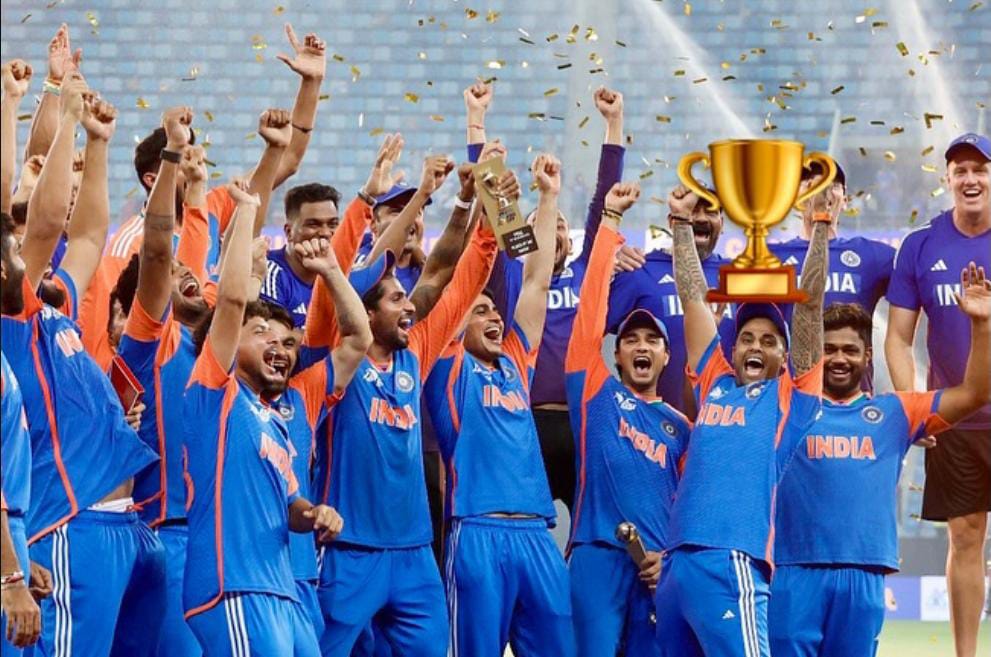
Dubai was painted blue. Not by desert winds or skyline lights but by 11 men who turned pressure into poetry. Who dominated the whole tournament and emerged victorious. The Asia Cup 2025 wasn’t just another tournament. It was a statement. And Team India made sure the entire continent heard it loud and clear.
From the first ball to the last cheer, this campaign had it all – dominance, drama, defiance and a final that turned from sport into spectacle.
The Road to the Final: Blue Fire in the Desert
India’s journey was pure intent. No fluff, no hesitation, just performance. Every match felt like a message “We’re here to win, not to talk.”
They opened their campaign with a ruthless demolition of UAE, chasing the small target within the power play itself, then walked into the marquee clash against Pakistan like gladiators entering an arena.
The result? Clinical. Calm. Crushing.
Surya Kumar Yadav’s men outclassed Pakistan not once but twice, first in the group stage and again in the Super Four, both times exposing the same cracks in Pakistan’s armour: brittle middle order, confused tactics, and nerves under fire.
Bangladesh and Sri Lanka tried challenging, but India’s rhythm was relentless. Even a Super Over thriller couldn’t shake their composure.
The young brigade – Abhishek Sharma, Tilak Varma, and Shivam Dube, played like they had centuries of experience behind them. By the time the final arrived, the Blue Army wasn’t chasing a trophy. They were chasing a climax to end this unbelievable campaign.
The Final: Nerves, Noise, and the Night That Stole the Spotlight
India vs Pakistan again. The script was cinematic. The tension was thick enough to slice with a stump.
Pakistan set 146 on a tricky Dubai pitch. Respectable, but never safe, not against this Indian lineup.
Enter Tilak Varma – the man with ice in his veins and steel in his shots. When wickets tumbled, Tilak stood unflinching. Every drive through cover, every flick off his pads felt like a quiet declaration of ownership: This stage belongs to me. His unbeaten 69 off 53 balls carried India home with two balls to spare.
Abhishek Sharma, already crowned Player of the Tournament for his explosive 314 runs at a strike rate near 200, watched on with the calm of a man who knew this was destiny fulfilled.
India lifted themselves, embraced, roared.
But what came next nobody could’ve scripted.
The Trophy That Never Found Its Hands
As cameras flashed and fireworks cracked, the unthinkable happened. Mohsin Naqvi, the ACC President and Pakistan’s Interior Minister, refused to hand the trophy to Team India.
Yes, the same trophy India had just earned.
He simply… walked away.
No handshake. No ceremony. No moment of triumph for the champions of Asia.
Captain Surya Kumar Yadav stood stunned, his teammates stranded mid-stage, and millions of Indian fans watching in disbelief.
The cup that symbolized supremacy in Asian cricket was snatched away by politics, literally.
Social media exploded.
Former players condemned the act. Even AB de Villiers weighed in, calling it “a disgrace to the spirit of sport.” The BCCI lodged a formal protest at the ACC’s annual meeting, demanding answers. None came.
And in that moment, the Asia Cup became more than a cricket tournament. It became a mirror reflecting how politics continues to shadow the subcontinent’s biggest rivalry.
The Aftermath: India Triumphant, Pakistan Tumbling
For India, this wasn’t just victory, It was vindication.
After years of narrative battles and boardroom noise, this team let the bat and ball do all the talking.
The Indian dressing room was pure emotion.
Surya Kumar’s smile said it all “You can take the trophy from our hands, but you can’t take the win from our hearts.”
Pakistan, meanwhile, imploded.
Reports emerged that the PCB had banned key players like Shaheen Afridi and Haris Rauf from overseas leagues, punishing them for “underperformance.”
Fans called it desperation. Critics called it denial.
And perhaps, in that chaos, you saw the difference:
India grew stronger through unity.
Pakistan fractured under pressure.
The Heroes of the Tournament
Abhishek Sharma – The fearless left-hander who made 314 runs look effortless. His aggression at the top redefined India’s powerplay batting.
Tilak Varma – The calm storm. A finisher in the making, his final heroics will be replayed for years.
Kuldeep Yadav – The silent executioner, taking key middle-over wickets and choking runs when it mattered most. Taking the key wickets and breaking the backbone of batting line-ups.
Axar Patel – Utility, composure, consistency. His balance gave India tactical depth every game. An all rounder with an all out ability.
Beyond the Scoreboard: What This Win Means
India’s victory went beyond cricket. It was a psychological sledgehammer, a reminder that the Men in Blue don’t just play … they dominate. With the T20 WC approaching the upcoming year, this has been an statement. They announced that the world champions was still as powerful as they were in 2024.Even without their veterans, this young squad showed maturity, grit, and the kind of mental toughness that defines champions.
The Asia Cup trophy might not have been physically handed over, but it doesn’t matter.
In every statistic, every highlight, and every memory. It belongs to India.
And as the Dubai night sky lit up with fireworks, one truth became crystal clear:
You can deny a ceremony, but you can’t deny supremacy.
India remains the undisputed King of Asia.
Final Word from BlueFever
For Indian fans, this was not just a win. It was poetic justice.
For cricket, it was a reminder that even amid politics and power plays, sport still finds its heartbeat in courage and character.
Asia Cup 2025 will forever be remembered as the tournament where India conquered the continent and walked away, trophy or not, as the true champions of the game.


