

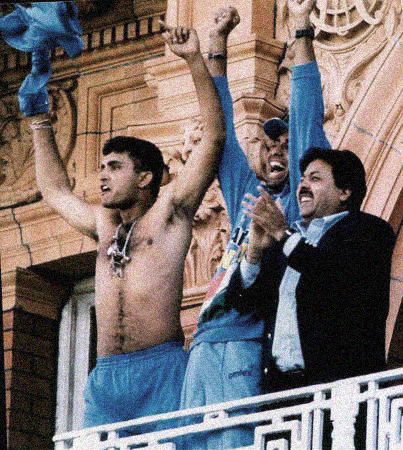
I was just four years old when it happened. July 13, 2002: a date that would become iconic in Indian cricket history, but to me back then, it was just another summer day. I had no idea what NatWest meant. I didn’t know who Sourav Ganguly was. And I certainly didn’t understand why a man had taken his shirt off and waved it from a fancy white balcony in London. But I do remember one thing clearly, the way my father reacted.
I don’t recall the match itself, but I remember the loud cheer, the laughter, the television being a little louder than usual, and my dad jumping with joy. I remember seeing him fist-pump and yell something in Bengali that I couldn’t understand at the time, but years later I would learn it was his way of saying, “This is our moment.”
As I grew older and time went by. Cricket slowly took over my own world, I started learning about that final. About the mountain of 326 runs. About Yuvraj and Kaif turning the impossible into reality. About how England had silenced us before, but that day, it was different. It was something else.
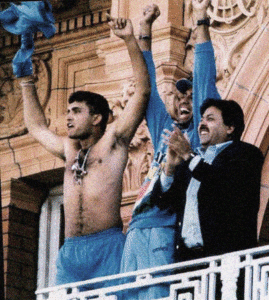
And of course, I discovered the moment that had become immortal Sourav Ganguly, shirtless, waving his heart from the majestic Lord’s balcony. My father, a die-hard Dada fan, would bring it up often. He told me it wasn’t just about cricket. It was about pride. About fight. About not taking a step back anymore and not breaking under pressure. That day, he said, Indian cricket stopped being polite and started being fearless. That was the moment the world got to know the future discourse the Men in blue would take.
I missed watching that moment in real time. But I’ve felt it a hundred times since. And listened to the tales a thousand times. Every time I watch that clip, I don’t just see Ganguly, I see my father’s voice in the background. I see a billion people roaring together.
And that’s how the story begins not with the toss or the chase, but with one raised shirt… and a nation rising with it.
Before the Roar Came the Storm
Growing up, whenever my father spoke about the NatWest Final, he never started with the match. He always began with how much we had lost before it. “There was a time,” he’d say, “when Indian fans didn’t believe we could win overseas. Not in a final. Not against England. Not at Lord’s.”
I didn’t quite get it then. I had grown up in an era where Indian wins were more frequent. I had seen India lift the 2011 World Cup. But to truly understand the 2002 NatWest Final, I had to go back and borrow my father’s memory.
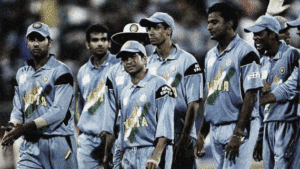
This was an India that had heartbreak fresh in its blood. We had lost the 2000 ICC Knockout final. The 2001 South Africa tour hadn’t gone well. And Lord’s? It was cricket’s cathedral, majestic, historic… but for India, always cold and cruel.
Then came the final.
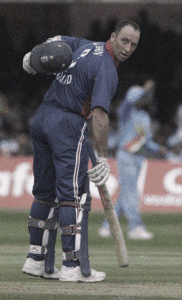
England batted first and batted big. Marcus Trescothick went after the bowling early on, and Nasser Hussain, their captain scored his first and only ODI century, full of grit and defiance. India’s bowling looked stretched. Ashish Nehra was expensive. Harbhajan and Kumble couldn’t find breakthroughs.
But Zaheer Khan stood out. The left-armer, still young and raw, struck with three wickets, trying to pull things back when everything seemed to be slipping. It wasn’t an easy day to bowl, but he kept running in, over after over.
Still, England kept the momentum and posted 325/5, a towering total in 2002. It felt like a mountain. Not just in numbers, but in the weight of history behind it.
I imagine my dad watching that total being put up and thinking, “Same old story.” But something felt different. There was a new energy in that Indian team. Ganguly had brought something raw and untamed into the dressing room, belief. There were young names like Yuvraj Singh, Mohammad Kaif, Zaheer Khan, Harbhajan Singh. There was Sehwag’s fire, Dravid’s calm, and Ganguly’s grit.
My father often says, “That wasn’t the best Indian team on paper. But they had heart. And Dada made them believe they were kings even before they had a crown.”
It wasn’t just a match. It was a battle of character.
And when England put up 325… it wasn’t just the players who felt the weight. It was every fan, already carrying the ghosts of the past, bracing for another final slip.
But what came next… was chaos, courage, and cricketing rebellion.
The Chase: Collapse, Hope, and Chaos
Every time I’ve watched that chase on YouTube the grainy old footage, the overexcited commentators, the nervous tension in the stands, it’s like stepping into a Time Machine, watching the special moment unfold once more. I wasn’t there when it happened, but I feel like I was, because I’ve lived that story through my father’s voice a hundred times.
India began like a storm.
Sourav Ganguly and Virender Sehwag came out blazing. Boundaries flew, the ball raced across the outfield, and within no time, India were over 100. Ganguly had made 60 off just 43 balls. Sehwag was tearing it up. Back then, this was rare. We weren’t used to Indian openers attacking in finals. We weren’t used to belief looking like this. It was new. It was thrilling. It was bold.
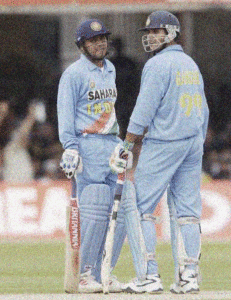
My father once told me, “For a brief moment, we all forgot to be scared.”
But then… came the collapse.
One wicket. Two. Then three. Suddenly, India was 147 for 5. Dravid gone. Mongia gone. Sehwag gone. The crowd silenced. My father said he switched off the TV for a few minutes. He couldn’t bear to watch. He had seen this same script before, the same team, same collapses in high press matches, and it never ended well.
But this was a different story. Because from the ruins stepped out two young men Yuvraj Singh and Mohammad Kaif, both under 23, both still raw, and both carrying the hopes of a nation too tired of heartbreak.
Yuvraj lit up the sky first. He didn’t play with caution. He played with fire. Sixes over cover. Flicks that screamed rebellion. That 69 off 63 balls wasn’t just a knock; it was a statement.
And then came Kaif. Steady. Calm. Almost invisible until it mattered. He ran hard, played straight, and never lost focus. When Yuvraj got out, people feared it was over. But Kaif refused to blink. His 87 of 75 was pure class. He found support in Harbhajan, in Zaheer, anyone who could hang around and stand on the pitch. He didn’t care about names. He cared about finishing. He cared about winning.
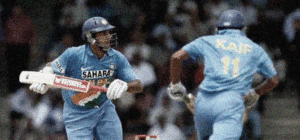
The final overs were madness. Every run felt like a heartbeat. Every boundary felt like a scream released. And when Kaif smashed that ball and ran for the winning runs… it wasn’t just the players running onto the field, it was every Indian fan running with them.
My father told me, “I didn’t cheer. I just stood still. My eyes were full. I’d never seen India do this. Not like this.” The quietness and stillness at the winning moment was very loud.
Me? I was four. Maybe I was asleep by then. But now, when I watch that chase, I feel like I’m watching a miracle unfold in real-time one forged not just in talent, but in belief.
A belief that we can win. That we will win.
And waiting on that Lord’s balcony, was a man who was about to let all that emotion explode, shirt first.
The Shirt: A Celebration Heard Across Oceans
If the winning run was the heartbeat, then the celebration that followed was the scream that had been building up for decades.
The image is etched into memory now.
Sourav Ganguly, shirt off, roaring from the Lord’s balcony, arms wide, unfiltered joy on his face.
When I first saw that clip years later, I was… confused. “Why is he shirtless?” I asked my dad. He just smiled, eyes distant, like he was back in 2002 again. He told me, “That wasn’t just celebration. That was release. That was revenge.”
And then he told me about what happened earlier that year.
Andrew Flintoff had taken off his shirt at the Wankhede after beating India. The crowd was stunned. The players were furious. So when India won at Flintoff’s own fortress, Ganguly responded in kind and in style. On the grandest stage of them all. At the most historic venue in cricket.
My dad said it felt like someone had stood up for us for all the times we were too quiet, too polite, too grateful just to compete. Ganguly changed that. In that moment, he wasn’t just a captain. He was a statement.
The world called it wild. Some said it was inappropriate. But back home? That raised shirt became a banner of belief. It wasn’t about ego. It was about emotion. About carrying a team through years of rebuilding. About battling doubt, criticism, and near misses. About leading from the front, taking the blows, and finally having a moment that was undeniably, unapologetically ours.
Whenever I see that clip now, I don’t just see Ganguly, I see what Indian cricket was becoming.
Brash. Proud. Fearless.
And I see my father, beaming with pride. Because that day, cricket didn’t just give him a win it gave him a memory. One he’d pass down to me, without even meaning to.
As I grew older and started watching more cricket, I began to understand something my father always knew, that moment at Lord’s wasn’t just about cricket.
It was bigger than a trophy.
Bigger than a shirt.
Bigger than the game itself.
Under Ganguly, a team of bold young men began to rise. Yuvraj Singh, who played like he had ice in his veins. Mohammad Kaif, who ran like every step mattered. Harbhajan Singh, Zaheer Khan, Virender Sehwag they were fearless, unapologetic, full of energy. They were us.
My father once told me, “We had legends before, but Ganguly gave us an attitude.”
Even now, more than two decades later, that image of Ganguly stands as a defining frame in Indian cricket history. He set a new set of fundamentals for the team and those still guide us.
Not just for the win, but for what it represented: The day India stopped being grateful to compete and started believing it could conquer.
It became an origin story for a new chapter in our cricketing journey, one that would lead to 2007, to 2011, to a generation of players who never feared the big stage again.
And for me, a fan who missed it live but inherited its magic second-hand, that moment is more than just something I watched.
It’s something I feel.
The Legacy: What Followed After the Roar
It’s funny how one moment can shape everything that comes after it. That raised shirt didn’t just go back into Ganguly’s kit bag. It found its way into India’s cricketing DNA.
After that win, something truly shifted. India was no longer the team that folded quietly under pressure. We became a side that stared you in the eye. That chased 300+ totals. That didn’t wait for legends to do the job, youngsters now demanded the big stage. They made the stage big, wherever they played.
Mohammad Kaif never had a long international career, but he was our hero that night. Yuvraj Singh went on to play the innings of his life in 2007 and 2011, but it all started with that 69 in the NatWest final. Zaheer Khan, the man who conceded 67 runs in the 2003 World Cup final, would come back as a leader of the bowling pack years later and would play a key role in the future endeavours of team India.
And then there was Ganguly. The captain who danced with euphoria at Lord’s didn’t just lead a team, he reformed Indian leadership.
It was Ganguly who backed a young MS Dhoni. It was Ganguly who gave players like Harbhajan and Sehwag the confidence to be themselves. And it was Ganguly who taught Indian cricket that it’s okay to show emotion, to wear passion on your sleeve or to tear it off and wave it in the air if the moment demanded.
The 2002 NatWest Final became a turning point, a reference in every debate about Indian cricket’s evolution.
My father still talks about it like it happened yesterday. He says it gave fans something they hadn’t felt in years dignified defiance. It wasn’t about hating the opposition. It was about finally loving our own fight.
Now, whenever I watch today’s stars – Kohli’s aggression, Rohit’s composure, Bumrah’s fire, Rahul’s class I can trace it back to that one day. That one chase. That one raised shirt.
And I realise, the real legacy of that final wasn’t just in the scoreboard. It was in the mindset.
At Bluefever, we believe moments like these don’t belong to history books.
They belong on your walls, in your stories, in the way you still fist-pump when you see that old clip. Because for true fans, cricket isn’t just a game. it’s memory, its emotion, it’s identity.
So, the next time you see that image Dada shirtless, smiling, roaring
Remember:
It wasn’t just a celebration.
It was a revolution.
And it still lives in every Indian fan who dares to believe.
So come join us,
Because
WeCelebrateCricket
Limited Edition Cricket Posters That Exude Passion * BlueFever
Own a piece of Indian cricket history. Blue Fever captures iconic match moments on high-quality canvas. Not sold to all…
bluefever.in


